LEGENDS from FRANCONIA and NUREMBERG
By Ernst Otto Luthardt and others, translated by Rudy Langmann
Eppela Gaila
At Drameisel near Muggendorf lived a knight whose name was Eppelin von Gailingen.
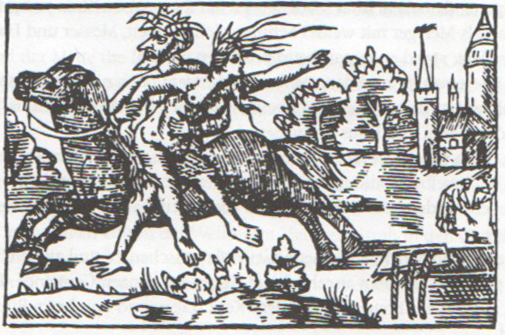
He was a mighty sorcerer and also the owner of a Winged Horse.
In Gailenreuth was his ancestral home, and yet he owned many more castles throughout the land, flying from one to another on his airborne steed, fast as the wind. From Drameisel he rode to Muggendorf over a tall hilltop and a steep mountainside, faster than anyone else could follow.
Toward the Nurnberger Eppelin had a sharp tongue; he associated with shady characters and rode often in their lead through the city of Nuremberg. Then the children would sing:
There rides the Nurnberger fiend
Eppela Gaila from Drameis
and
Eppela Gaila from Drameisl
rides always fourteenth out
The number fourteen had no doubt a secret meaning in eastern Frankenland, as also seen in the Vierzehnheiligen (the fourteen holies).
A prize which the Nurnbergers certainly would have liked to collect themselves was set on Eppelin's head. At one time he was attacked at the castle where he had taken up a defensive position, and hard pressed by the foe who had closed the city gate and now were yelling at him that now they had him and he was soon to be hanged, he steered his horse toward the city wall, giving it the spurs and yelling back:
The Nurnberger hang no one,
E'en if they had him afore!
And with one mighty leap he cleared the wall as well as the deep and wide moat on the other side. He had luckily made his escape.
With astonishment the pursuers looked at the horseshoe marks on top of the wall.
After many unsuccessful attempts at catching Eppelein, the knight finally came to Farnbach where he checked in at a herberge. He was betrayed and while he lay sleeping the Nurnbergers built a wagon ring around the hostel. When he woke up he mounted his horse and jumped across eight wagons but "over the roof of the ninth", so goes an old song, "his luck ended" and when he couldn't get any further he offered up-like a Reinhold von Dordone-his faithful wonder horse and was taken prisoner. That happened in the small town of Neumarkt, between Nurnberg and Regensburg, where he soon lost his head to the executioner's sword. His memory endures.
How the Nurnberger name "Herrgottschwarzer" (Our Black Father) came about
Between the two towers in the mid-window of the Loffelholz chapel in the Saint Sebaldus church in Nurnberg, or the so-called Engelschorlein, (Angels Choir) hangs a crucifix of brass, which in the years of stark faith was placed there by the brothers Johann and Georg Stark and redone in the year 1625.
This crucifix is one of the oldest and still existent works by a Nurnberger metal sculptor; unfortunately the artist is unknown.
Still, with reference to legend, the Nurnberger burghers say that this crucifix at one time was made in the same size of silver or that it still is of silver, and they call it the silberen Herrgott (Our Silver Father).
When it was renovated in 1625 (which also was done in 1689), the city council supposedly ordered it painted black, to prevent the soldiers travelling through the town from lusting for it.
From this time the name Herrgottschwarzer (Our Black Father) is used by out-of-towners, such as people from the villages of Altdorf, Fuerth and Lauf, when teasing their Nurnberg neighbors.
Water turns into Wine
A well-known Christmas Night Miracle, still very much alive, is that at the time the clock strikes twelve midnight, and for as long as the clock sounds, wine instead of water runs through the city wells.
But seldom is an attempt made by anyone to prove this as well as other miracles.
Now, at one time in the village of Riedenheim there lived a young girl who dared go to the well during the Christ midnight hour to fill her pail.
Trembling with joy she carried the pail home.
There she was met by a black man with blazing eyes who wore a red feather in his cap. He grabbed the girl and said to her:
In your pail you carry wine,
For this your sin you are mine.
Pulling the pail away from her and throwing it on the ground where it was found empty the next morning, he sped with her through the air and disappeared.
The Devil grabs his victim
Saint Sebald as a Helper
It must have been at Christmas time. In any case it was freezing cold and the snow was piling high.
Sebald wandered through the neighborhood and he was bitterly cold. Suddenly he spotted a light up ahead and stumbled towards it.
It was a tiny dwelling, and behind the window a lamp was alight. Sebald knocked on the door and an old woman answered, asking what he wanted.
He pointed to the snow raging around him and asked if he could enter the cabin in order to warm himself a bit.
The woman agreed, but when he entered the house he found it there even colder than outside and the oven without a fire.
A man and a youngster sat the table wrapped in rags. The old man said: "What do you want here? I have not invited you in!"
"Do not listen to him. He is a greedy old crow," whispered the boy.
"What's what," continued the oldster, "We have no wood, If the icicles on the gate outside would turn into boughs, that would be fine. But my wood is not to be touched."
Sebald asked the youngster to bring him some icicles. Then he placed them on the oven, murmured a prayer and finally lit them afire.
It didn't take long before the whole house was warm and cozy,
The old man, too, was warmed at the heart. He pleaded with the visitor to put an end to his miserly conduct as well, and Sebald also performed this miracle.
(The Sebaldus church in Nurnberg kept the holy man's spirit alive. His tomb took shape in Peter Vischer's workshop during the years of 1508 and 1519. This sarcophagus is one of the best well-known monuments in all of Germany. Sebald was a Danish prince who sometime during the ninth century chose to live as a hermit in the forest outside the Franconian town. He became known as Nuremberg's 'Schuetzheiligen' or protective saint.)
About Seifriedsburg
There was a shepherd, Fritz by name, and by relatives known as Sow-Fritz because he was looking after the pigs.
Once he led his herd into the clear water of the river Saale. There he found a stone which he scraped and fastened to a stick. He joined a fighting army and because he was invulnerable, by his courage he won high rank and riches.
From the local lord of the manor he obtained permission to build a castle and he chose for a location the small town where he was born and raised; there he built a castle on the mountain, and this and the local village because of his childhood nickname became known as Saufritzburg.
Later the spelling of the name was changed to Seifriedsburg.
For a long time the castle stood there, until some fine day a severe storm hit the area while the local farm hands were haying. Everyone was hurrying towards home; only a brave young girl remained in the field, yelling:
Eye, it may thunder and lightn',
But I must stack my hay housn!
At that exact time a lightning bolt struck the workers, throwing the young girl to the ground and setting the castle on fire, gutting all the hay fields from the castle right down into the valley.
Since then the Seifriedsburg has remained a ruin, but the village carries on the name.
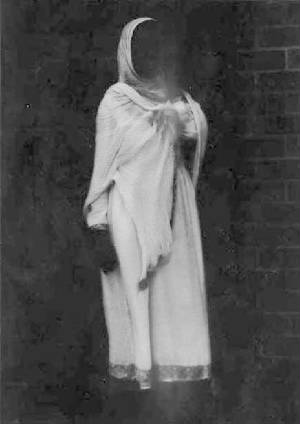
The Countess von Orlamuende, or the Lady in White
Otto, the count of Orlamuende died in 1340 (according to other sources in 1275, 1280, 1298) leaving behind a young widow, Agnes, a born duchess of Meran, with whom he had fostered two children, a small son of three and a two-year-old daughter.
The widow sat in her chamber at Plassenburg near Kulmbach, thinking that it would be nice to marry again, and one day she was told about 'Handsome' Albrecht, the Hohenzollern count at Nuremberg who should have uttered: 'I would be happy to marry the beautiful widow was it not for four eyes watching.'
The countess thought that he was referring to her two children, and that they were a hindrance to her marriage and future happiness. So, blinded by selfish emotion, she ordered a servant named Hayder or Hager to kill the toddlers, for which she gave him rich gifts. According to legend the boy had heard about the plan and pleaded with their assigned killer to let them live, saying:
Dear Hayder, let us live! For that I will thy Orlamuende give!
And the girl added: Dear Hayder, let us live! For that I will thy all my dolls give!
But the murderer was not touched and committed the crime. After he later had carried out other pranks and was lying on the bed of torture he confessed to the dastardly deed, and told about how the young master had been aware of the plan fostered by his mother and had pleaded for his and his sister's lives.
The corpses of the two children were interred at Kloster Himmelkron.
According to another legend the countess killed the children herself by sticking needles deep into their soft craniums.
Count Albrecht, however, had meant his own parents, and after the murder
| became public knowledge he no longer wanted to marry Orlamuende.
Further the story continues, that she remorsefully made a pilgrimage, walking barefoot all the way from Kulmbach to Rome and died outside the Himmelkron church on her return. But ordinarily it is said that she walked from Plassenburg to Himmelkron wearing a pair of shoes that were studded on the inside with needles and nails, and that she fell over dead when she reached the church were her children were buried.
|
How to live to be a hundred
Martini, the eleventh of November, is one of the best days of the year for butchering. But one must not forget that meat and sausages for a long time and for most people have been almost foreign words. That this also has its good side will the following anecdote bear witness to:
At the time of the last prince bishop, Christoph Franz, there lived in Buchsbach near Teuschnitz a man, 103 years old, who still was astoundingly fresh, hale and hearty, with a grip on all things.
When the sovereign came to Teuschnitz and was told about the old man he asked that he come before him and then asked him about his lifestyle.
The jolly oldster answered that he hadn't married until the age of 34, and that he always had worked hard at whatever he had to do. Besides, he never did bite into anything else than in the morning a burnt watery soup, at noon sauerkraut and dumplings, very seldom with a small piece of black meat, and in the evening potatoes and milk, and with every meal a drink of fresh water.
The high and mighty lord decided to do the old man a good turn and gave him a small jointure with the clause attached that he truly every day were to consume a bowl full of broth and now and then also empty a tankard full of beer, all in order to strengthen his constitution.
About nine months later the beneficiary fell ill.
When he realized that it was nearing the end, he proclaimed: 'If I never had met that prince and never had eaten his broth I would have lived on for a long time yet.'
Charlemagne
Many years ago a man was condemned to the gallows by the Nuremberg city council for his criminal activity. But when the time came for his execution he was told that his life would be spared if he would agree to do something that nobody else had dared, go far down into the Tiefe Brunnen (deep well) on the castle grounds. There, he was told, he would find a door to which they would give him the key, and he was to enter and investigate the source of the noise that had sounded for some time, a loud rumbling noise.
Understandably the man was delighted to be given this chance to save his life, and immediately agreed to the proposal.
He was handed the key and a lamp to use in the deep confines of the well, and was lowered down.
As he had been told, he discovered the door, unlocked it, and now found himself inside a dark hallway. Lighting the lantern, he slowly walked on and could now hear the noise getting louder and louder as he progressed. He finally came to a corner in the gallery where, hiding behind a pillar, he spotted a great number of men in full armor seated around a huge oak table eating and drinking and having a grand old time.
Suddenly, however, he was spotted by some of the warriors who got up from the table to run after him.
He had to run for his life but reached the door just in the nick of time, slammed it shut behind him and turned the key.
Quickly, he was hoisted back out of the well, and here he had to report to the officials about what he had seen down below. As promised, his life was spared.
And the good citizens of Nuremberg now knew what that noise down below was all about. It was Karl der Grosse (Charles the Great, also known as Charlemagne) and his men partying in the great hall deep below the emperor's castle above. And whenever the noise could be heard on the ground above they knew it was the old king and his true knights feasting or perhaps riding to hunt in the hallways underground.