| | AN EARLY HISTORY | |
| | The Baltic Sea Port of Rostock in Mecklenburg-Pommern | |
Going back 2,000 years or more, this vast country of lakes and moors reaching to the southern coast of the Baltic Sea had been inhabited by Germanic tribes, but during the Great Tribal Migrations at the start of the Middle Ages the Germans had been replaced by an influx of Slavonic people from the east. For many centuries to follow, the Slav-born dukes were liegemen to the kings of Denmark after their lands had been conquered by Danish Vi Kings in the 12th century. The Slavs were still heathen when King Valdemar the Great together with his battleaxe-swinging archbishop Absalon subdued the Wends at Arkona on the island of Rügen as well as parts of the mainland by fire and the sword in 1161 and 1168, and as sea-going pirates the locals had made countless plundering raids on the Danish islands, thereby prompting the invasion of an annoyed ruler. By Valdemar and Absalon they were forced into accepting the Christian faith and to end their thievery and their murderous ways.
Early history of what happened, a dateline
The founding of the City of Rostock goes back nearly 800 years. Rostock obtainedits town charter in 1218 and its early development was closely tied to the LübeckerHanse, a German trade commonwealth that had existed since the middle of the 12thcentury.
In 1161, the town was first mentioned by the Danish historian Saxo Grammaticus;by about 1200 it had become a thriving settlement of German craftsmen and tradespeoplewho, encouraged by the Saxon duke Heinrich der Löwe, had moved to the sparselypopulated marsh lands from the German-Roman cities in the south on both sidesof the Alps.
In 1218, Rostock was granted tax freedom by Duke Heinrich Borwin I of Pomerania.In 1252, the town purchased the Rostocker Heath, and in 1265 the unificationofthethreeseparate sections to the town was established.
Building of the town's defence walls began that same year, and in 1323 the purchaseof the nearby fishing village of Warnemünde, about eight miles distant,wasconcluded.
As a free imperial city, Rostock purchased the right to mint its own coins fromthe German emperor in 1325 and the city fathers that same year proclaimed theRostock Coinage Act.
In 1358, the acquisition of full jurisdiction by local government was obtained,and 1419 saw the formation of "Alma mater rostochiensis", the firstuniversity in northern Europe.
In the year 1472 the astronomical clock in St.Marien (St. Mary's Church) wascompleted and installed.. | | 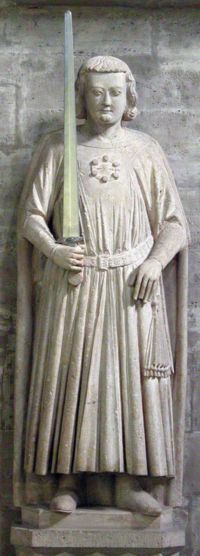
Heinrich Löwe (Henry the Lion) |
Confirmation of Lübecker law city rights, 1218
In the 11th century Polabian Slavs founded a settlement at the Warnow river calledRoztoc (which means broadening of the river); the name Rostock is derived fromthat designation.
The Danish king Valdemar I 'the Great' set the town ablaze in 1168.
After this followed a re-colonization and the place was quickly settled by German merchants. Among these were members of the Langmann clan and other patrician families who moved there from the imperial cities of Nürnberg, Augsburg, Frankfurt and Ulm, the long-established trading centers of central and southern Europe.
At the beginning there werethree separate fledgling towns at the mouth of the Warnow river:
Altstadt (Old Town) around the Alter Markt (Old Market) with St. Petri (St. Peter'sChurch),
Mittelstadt (Middle Town) around the Neuer Markt (New Market) with St. Marien(St. Mary's Church) and
Neustadt (New Town) around the Hopfenmarkt (Hops Market, now University Square)with St. Jakobi (St. James's Church, now demolished).
| | 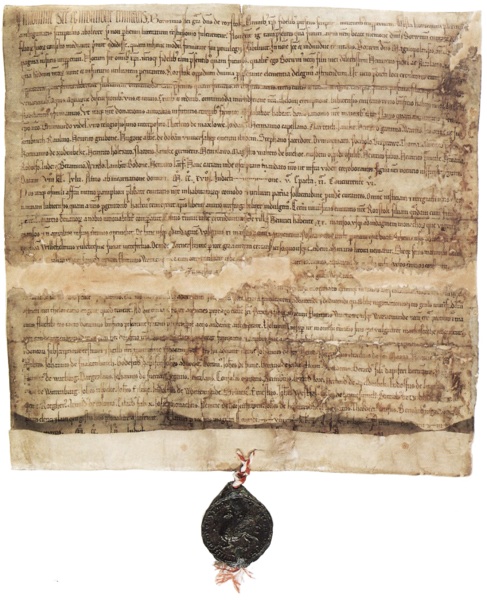
Rostock Hanseatic City Charter, issued in AD 1213
| |
Important member of the Hanseatic League
The rise of the city began with its membership in the Hanseatic League. In the14th century Rostock was a powerful seaport town with 12,000 inhabitants and by far the biggestcity of Mecklenburg-Pommern. Ships for cruising the Baltic Sea were constructed in the local shipyards.In 1419 one of the oldest universities in northern Europe, the University ofRostock, was founded.
15th to 18th century Rostock
At the end of the 15th century the dukes of Mecklenburg succeeded in regaining the complete rule over the town of Rostock, which had until then been only nominallysubject to their rule and essentially independent. They took advantage of a public riotknown as the Domfehde (church feud), a failed uprising of the impoverished population. Subsequentquarrels with the dukes and persistent plundering led ultimately to a loss ofeconomic and political power as the Hanse fell apart.
City life inside the walls during 1780-90
The strategic location of Rostock provoked the envy of its rivals. Danes andSwedes occupied the city twice, first during the Thirty Years' War (1618-48)and again from 1700 to 1721. Later, the French, under Napoleon, occupied thetown for about a decade until 1813. It was here that Gebhard von Blücher, who was actuallyborn in Rostock and who was one of the few generals to fight on after the battleof Jena, surrendered to the French in 1806. This was only after furious streetfighting in which he led some of the cavalry charges himself. The exhausted Prussianshad, by the time of the surrender, neither food nor ammunition.
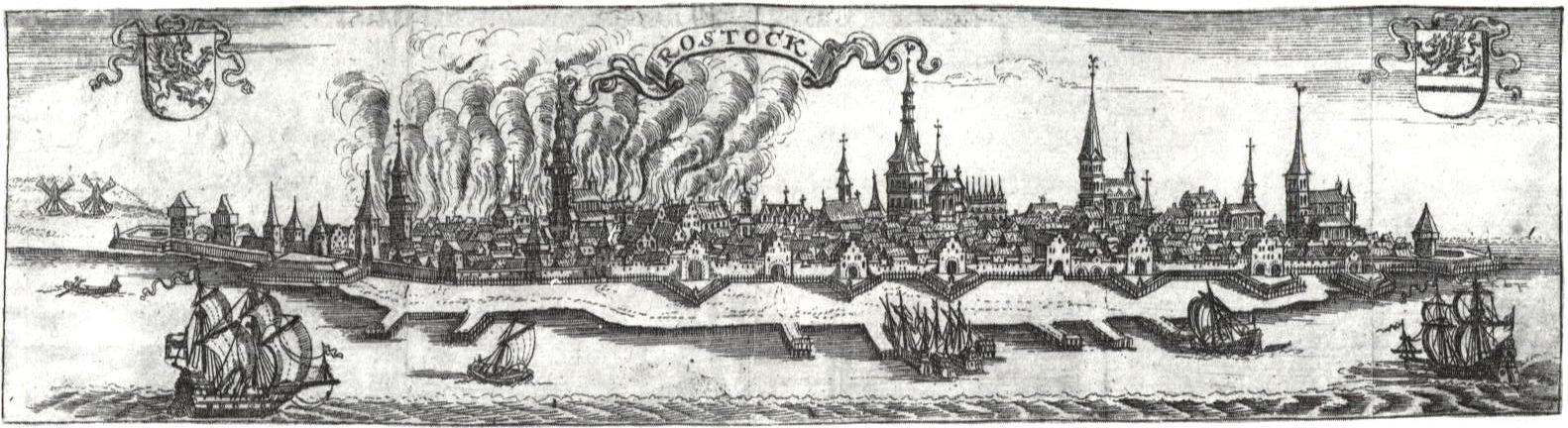
Firebrand! ---In 1677 more than half of the city burned to the ground, reducing the population to about 5,000.
The farmers outside of the city walls were basically serfs and remained as such until well into the 19th century, while most of the lands and forests for centuries were owned by the landed nobility. In contrast, the trades people and merchants inside Rostock proper--as was the case in most other imperial cities--were citizens and freemen, if not members of the ruling class consisting of the city nobility.
18th and 19th century in the city on the river
In the first half of the 19th century Rostock regained much of its economic importance,at first due to the wheat trade, and, from the 1850s, to industry, especiallyto its shipyards. The first propeller-driven steamers in Germany were constructedhere.
The city grew in size and population, with new quarters emerging in the southand west of the ancient borders of the city. Two notable developments were addedto house the increasing population at around the turn of the 20th century:
Steintor-Vorstadt in the south, stretching from the old city wall to the facilitiesof the new Lloydbahnhof Railway Station (now Hauptbahnhof). It was designed asa living quarter and consists mostly of large single houses, once inhabited bywealthy citizens.
Kröpeliner-Tor-Vorstadt in the west, designed to house the working populationas well as smaller and larger industrial facilities such as Mahn & Ohlerich'sBrewery (now Hanseatische Brauerei Rostock). The main shipyard, Neptun was justnearby at the shore of the river.
(From Wikipedia and other sources)
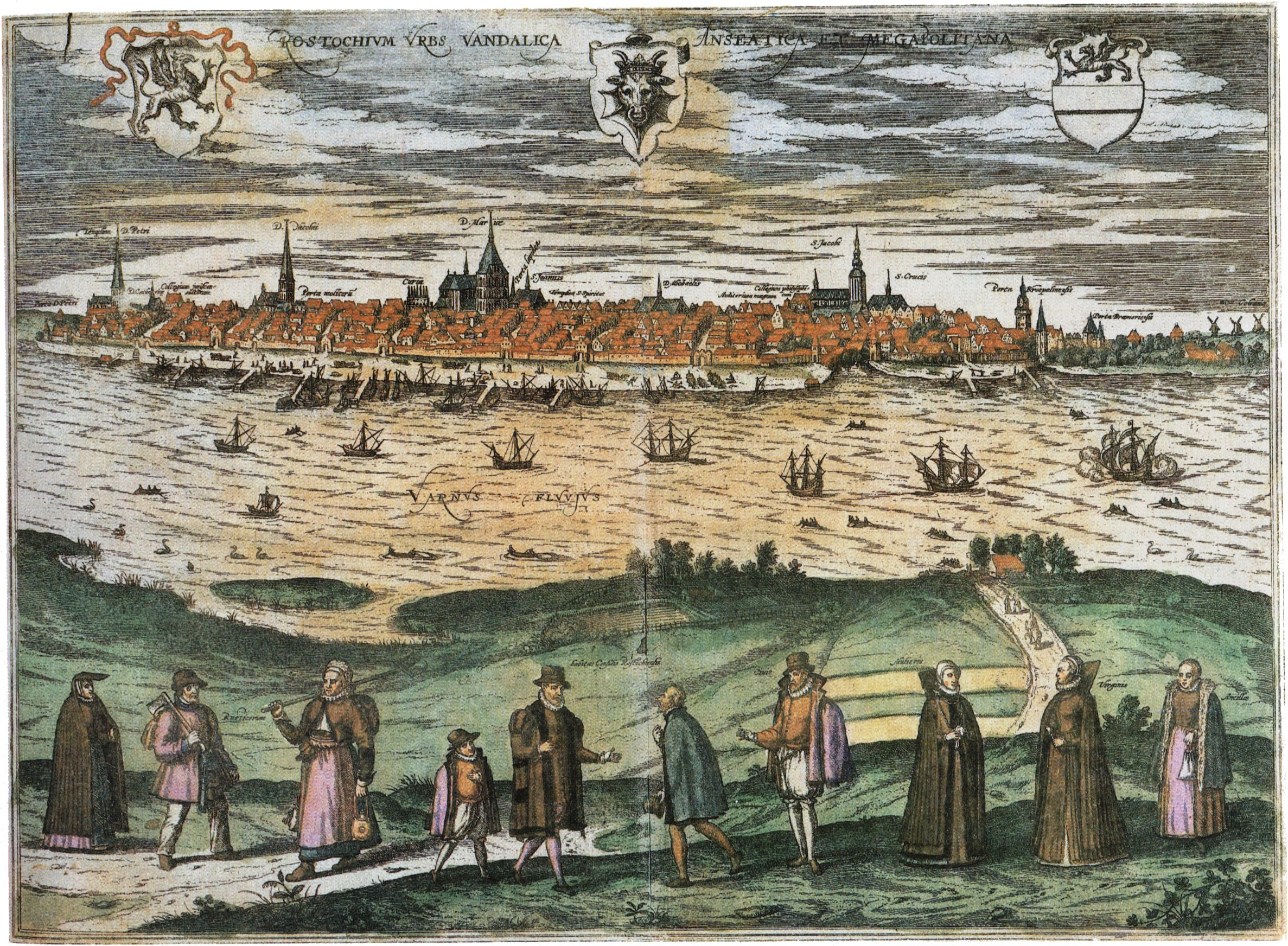
Rostock panorama viewed across the river Warnow, Anno about 1590. In the foreground are seen a city councilor with his son greeted by a commoner with hat in hand, then a nobleman, merchant wives, chambermaids and to the left a farm couple. (Drawing by Franz Hogenberg, Flemish 1540-1590)