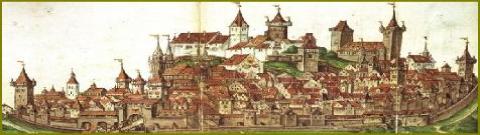
Rebellion in Nuremberg, 1348
(Aufstand in Nürnberg)
By Rudolf Langmann
It had been brewing and bubbling under the surface for some time, but it came to a head on Wednesday, June 4 in the year of our Lord 1348.
The night before, a journeyman butcher had happened to overhear a conversation between two other tradesmen sitting at an adjacent table in a local tavern and had learned that an uprising was in the offing. He had quickly left the pub and rushed down the street knocking on a few doors, told the people who had come to the doors what he had just heard, and hurried on. From then on the word spread like wildfire, 'Rebellion!'
That same night there was an exodus from the old city republic. The portals in the wall surrounding the town had been locked up for the night but were quickly busted open and a stream of citizens, on foot, on horseback and in horse drawn carts were fleeing into the bright summer night, the throng scattering in all directions. Individuals and entire families were on the move. The very richest of the patricians hurried to the safety of their estates in the countryside, others to the convents in the nearby small villages, and senate members took refuge with the nobleman Konrad von Heideck at his castle near Eichstatt about 20 miles south of the city. Heideck was a relative of the bishop of Eichstatt, the chief representative of Rome in all of Franken.
When the dawn came the last of the burghers were still scurrying away, but by now it was done surreptitiously with individuals hiding under loaded wagons and some males simply walking out of the city dressed in poor woman's clothing.
The escapees were all members of the city aristocracy, rich merchants, manufacturers, shop keepers and city senators with their families, but because of the immediate urgency most had only managed to load up a very few of their belongings. The main thrust was simply on getting away.
That Wednesday morning the revolution started. It was led by Hermann der Haubenschmied (the helm smith), his brother Ulrich, and a man simply known as Rex. The cheering masses soon filled up the main city square and the leaders of the insurrection stormed into the city hall and once in there rushed into the treasury chambers.
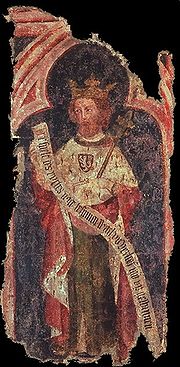
Karl IV (1347-1378)
Who were these revolutionaries, and what was spurring them on? Their leaders were journeymen blacksmiths joined by individuals from other guilds or trade unions but also by some disgruntled members of the aristocracy, among these individual members of the rich and influential Ebner, Stromer, Ortlieb, Maurer and Waldstromer families. Landschreiber (government scribe) Friedrich Ebner had also remained behind, and he was to keep his position under the new regime. This was led by the quickly installed new burgomaster, Rudolf Geisbart, and his senators who included brothers Konrad and Fritz and son Konrad II. The command of the city militia regiment had been taken over by the revolutionaries early that same morning.
The cause of the unrest following the death of emperor Ludwig der Baier was partsocio-economic, part political and part religious, and as for the disgruntledpatricians they had their own agenda, they had been individuals on the fringeof the establishment, people with money but with only limited power. Some werelater said to have remained in the city in order to spy on the new rulers andsend word to their compatriots on the outside.
Nurnberg had at that time for almost three centuries been ruled by a republicanoligarchy consisting of two chambers, an outer and an inner council, and theburgomaster and senior senators were only subject to the supremacy of the emperorof the Holy Roman Empire. A republic in the mold of the Italian cities, yes,but very far removed from a democracy, with only a handful of men in the GeheimeRath (inner secret council) ruling with an iron hand. The city was rich, oneof richest trading centers in all of Europe, and enjoyed many privileges suchas free trade with other cities within the empire and considerable tax concessionsgranted by the imperial ruler. Lately artisans of every craft and skill fromevery corner of the German-Roman empire had been streaming into the prosperingcity, and this had resulted in a glut of workers and a subsequent pressure onthe guilds with increased competition, rising unemployment and a drastic loweringof the living standard of the workers. The senate had failed to do anything aboutthis, and in fact had imposed more stringent regulations on the workers. Althoughall citizens living within the walls were free men, in contrast to the land-boundserfs of the countryside, the city fathers dictated just how much any tradesmancould charge for his work, and among the civilians only members of the rulingpatrician class were allowed, by city ordinance, to wear clothes of silk andother finery and to bear arms, swords and daggers.
But Karl IV, the king and self-proclaimed emperor of the house of Luxembourg,was in his castle in far away Prague in Bohemia and he had troubles of his own.He was on the outs with the pope in Rome and he also had to fight two other politicalparties, the Habsburgers and the Wittelsbachers, in order to retain the crown.He had no time to take care of the anarchy in Nurnberg.
To make things worse, the bubonic plague, the Black Death, had reached acrossthe Alps from northern Italy where it had devastated whole cities and provinces.Southern Germany was hit by a series of earthquakes and the oncoming winter struckhard, with lots of snow and freezing temperatures throughout Franken. Robberknights attacked the trade caravans on the trails going north, south, east andwest, and after every attack retreated to the safety of their castle strongholdswith their booty.
In the months to follow the new city administration in Nurnberg was unable tocope effectively with the situation. Inefficiency and corruption ran rampant,and when the good citizens of Frankfurt, Mainz and Rothenburg started dying likeflies from the pest, someone--it is not known who--came up with the idea of whator rather who had been the cause of all of this misfortune. The Jews. Soon apogrom swept the land and the Jews in the city of Nurnberg--there were about1,200 of them at the time (or about 10 percent of the population)--took refugealong with some non-jewish sympathizers in the courtyard of the old imperialcastle on the hill. The crowd stormed and the defenders, men, women and children,were all slaughtered. According to old documents, 628 people died inside thecastle ramparts on June 28, 1349. The Israelites had nominally been under thespecial protection of the imperial court--for which service they for many yearshad been paying Judensteuer (Jew tax), but again Kaiser Karl did nothing beyondselling this lucrative part of his tax department to the Electors in the Rhineland-Palatinate.
Fifty-one years earlier, in 1298, another pogrom had originated in the smalltown of Röttingen when a knight known by the name of Rindfleisch roundedup and burned 21 Jews at the stake. Their crime? Allegedly they had desecrateda host in a local Christian church, and the atrocities at that time swept fromtown to town throughout Germany and Austria taking thousands of lives.
This time, in 1349, the Jews were accused of having received supplies of a specialconcoction of poison made up by a fellow Israelite in Portugal with which theyhad contaminated the city's wells, thereby helping spread the pestilence andboost the death toll among the Gentiles. The allegations were of course deniedand countered with accusations that the Christian zealots really had embarkedupon the massacres in order to wipe out their personal monetary debts to theJewish money-traders and money-lenders.
When the two other contenders to the imperial throne, the Wittelsbacher Gunthervon Schwarzburg and Friedrich von Habsburg passed away in 1348 and 1349 Karl'shold on the crown became suddenly more secure and he finally found the time tolook after more pressing matters. He settled his differences with the pope andin the late summer of 1349 he journeyed from his palace in Prague to his castlein Frankfurt, and from there, towards the end of September he turned with hisarmy towards Nurnberg. For three days the imperial troops lay in bivouac at Mögeldorfjust outside the city walls. Then the attack began on September 27. It didn'tlast long. The emperor made his triumphant entrance into the city and in thedays to follow the renegade senators were brought to trial, and amnesties andpardons handed out to some members of the old guard. Several members of the oldpatrician families, including Konrad Waldstromer, Otto Forstmeister and Hansand Friedrich Fischbeck had already been pardoned by imperial decree of June26 the same year. On October 1, Konrad Stromer and Georg Forchtel were swornin as the two new judiciary burgomasters and the old senators--among these Hansand Otto Langmann--returned to the city from exile a few days later in orderto resume their positions in council. The court of the reconstituted senate dealtharshly with the revolutionaries who had held on to the power for 16 months.Of the leaders of the revolt some were sent to the gallows while others weresentenced to drowning in the Pegnitz and a great number were banished fromthe city, some for a number of years, others for 'eternity'. And the butchers guildwas awarded special privileges by the town fathers because they had remainedfaithful to the old establishment. As a consequence the first Schembart (maskbeard) carnival was held in Nurnberg in February of 1350, under the auspicesof the Metzgers (butchers guild) and with the blessings of the senate.
The revolution of 1348 had come to an end. The surviving Jews returned to thecity in 1352. And the Black Death raged on until it finally seemed to have wornitself out seven years later. By that time it had wiped out about one quarterof the total population of Europe.
© 2009 Rudolf Langmann
Quellen (Sources):
Nurnberger Geschlechter und Familiengeschichte
Nurnberger Wappenbuecher Nr.211-312
211 - Nurnberger Geschlechterbuch sog.Hallerbuch (Blatter 1-549) 1533-36
212 - Text des Hallerbuches (Konrad Haller?)
213 - Nurnbergisches Geschlechter- und Wappenbuch des Christoph Derrer 1620
214 - Nurnberger Schembartbuch (104 Bl.) 1449-1525
215 - Das Hochzeith Buchlein der Erbaren in Nurnberg 1547
216 - Handschrift Hochzeitbuchlein, Ratstotenbuchers 1352-1644
217 - Handschrift betitlet Nurnberg (6 Teilen, mit Register)
218 - Nurnberger Wappenbuch vom Jahre 1583
219 - Fortsetzung des Nurnberger Wappenbuches von 1583, Band II (Kaufleute)
220 - ibid., Band III
221 - ibid., Band IV
222 - ibid., Band V
223 - ibid., Band VI
224 - ibid., Band VII
225 - Nurnberger Wappenbuch (bez. Heinrich Max. Oelhausen)
226 - Nurnberger Sammelband (Siegel,Wappen,Turniere)
227 - Todlicher Abgang Etlicher hohen Potentaten (Balthasar Streun)
228 - Dreiundachtzig Kupferstiche zu einen Nurnberger Geschlechterbuch 1610
229 - Wappen- und Geschlechtsregister (291 Bl.) 1654 Joh.Georg Fleischmann
230 - Nurnberger Geschlechter 1610
231 - Nurnberger Wappenbuch (17.Jh.)
232 - Hochzeit Buch 1625 Andreas Pessler
233 - Genealogischen Nachrichten uber die Nurnberger Familien
234 - Nurnberger Wappen (Johann v.Tartzhausen)
235 - Geschlechter Buch
236 - Fortsetzung des Geschlechter Buch (235)
237 - Nurnberger Geschlechterbuch
238 - Historische Bemerkungen uber Nurnberger Familien
239 - Chronologische Notizen (wertlos)
240 - Genealogische Aufzeichnungen Nurnberger Familien (Satirisches Gedicht)
241 - Verzeichniss Genealogische Aufzeichnungen (240)
242 - Lexikon genealogicum Patriciarum Familiarum urbis Imperialis Norimbergae (Martin Pfinzing)
243 - ibid.
244 - Imhoff, Joa.Jac. Norimbergensium Familiarum Genealogiae Insignatur
245 - Sammelband
246 - Imhoff Norimbergensium Genealogiarum
247 - ibid.
248 - ibid.
249 - ibid.
250 - ibid.
251 - ibid.
252 - Geschlechterbuch
253 - ibid.
254 - ibid.
255 - Imhoff, Crist.Jacob Geschlechterbuch
256 - Historische Notizen
257 - Nachrichten uber Nurnberger Familien
258 - Geschlecht-Buch deß Heil.Rom. Reichs Statt Nurnberg (Verfasser ungenannt)
259 - Zu Rath gehenden bis 1729
260 - Nurnberger Sammelband
261 - Adels Probe des Teutschen Patriciats
262 - Adelichen und beruehmten Geschlechter 1820
263 - Nachlass des 1901 verstorbenen kgl. Kreisarchivar Dr.A.Bauck
264 - Cunrad Paumgarthers des eltern Handschrift (Jacob Tucher, 1538)
265 - Geschlechterbuch der Baumgartner 1676
266 - Familienchronik (Geburtsbuch) der Nurnberger Familie Bayr
267 - Handschrift (Zwei Originalbriefe)
268 - Geschlechtschronik der Familie Freydel
269 - Juristiches Gutachten
270 - Landtguttes die Fuerer
271 - Geschlechts- und Wappenbuch der Familie Fuerleger (Wolf Furleger 1521)
272 - Genealogie der Nurnberger Familie Glockengiesser 1650
273 - Familienchronik des Christoph Glockengiesser 1526-1554
274 - Verwaltung des Spitals zu Lauf
275 - Historisches Tagebuch Familie Gugel
276 - Einer Reise durch die Schweiz, Frankreich und die Neederlande (Hier.Gugel)
277 - Briefe an Mitglieder des Nurnberger Familie Gugel
278 - Geschenkstabellen vom 13.-18. Jahrhundert (Haller von Hallerstein)
279 - Genealogie der Nurnberger Familie Harsdorfer
280 - Geschlechterbuch der Familie Heffrich
281 - Gesclechterchronik der Nurnberger Familie Holzschuher seit 1258
282 - ibid. beg. 1263
283 - Genealogie des Imhofischen Geschlechtes 1565-68
284 - Imhoffiorum Genealogie 1334-1598
285 - Geschlechterbuch der Familie Imhoff
286 - Collectanea Imhofianae
287 - Fortsetzung Collectanea Imhofianae
288 - Aufzeichnungen uber das Geschlecht der Imhof
289 - Familiae Loffelholz
290 - Handbuch Bernhard Muellers
291 - Die Gut vnd die Guelt die den Paulus Muffel angehoeren
292 - Johann Wilhelm Muffel v.Eschenau (Gedicht)
293 - Muffelscher Familienchronik 1897-1902
294 - Stammbuch der Familie Ockersel aus Antwerpen, Niederlande
295 - Pfinzing von Henfenfeld Privilegienbriefen, Stamm- und Wappenbuch
296 - Genealogie des Herrn von und zu Polheimb
297 - Stammbuch des Michael Posekiss 1602-15
298 - Familiechronik der Familie Roggenbach
299 - Willibald Schluesselfelder Tagebuch
300 - Familienchronik des Matthaus Schreiber
301 - Sebald Schreyers Gedenkbuecher
302 - ibid. Band II
303 - ibid. Band III
304 - Peter Stainbachs Hochzeit-, todt- und taufbuchlein 1595
305 - Hans Tetzels Salbuch 1464 (Tetzelsche Schlosschronik von Kirchensittenbach
306 - Genealogie der Familie Tetzel
307 - Herdegen Tuchers Salbuch
308 - Atlas Genealogicum Familiae Tucher
309 - Salbuch die Valtzner'schen Guter und Lehen
310 - Hans Watstromeyer 1465
311 - Das Geschlecht des Herrn Waldstromer v.Reichelsdorf
312 - Stammbuch Album des Joh.David Welser 1640 (Stammbucher Joh.Georg Muck und Familie Mendel
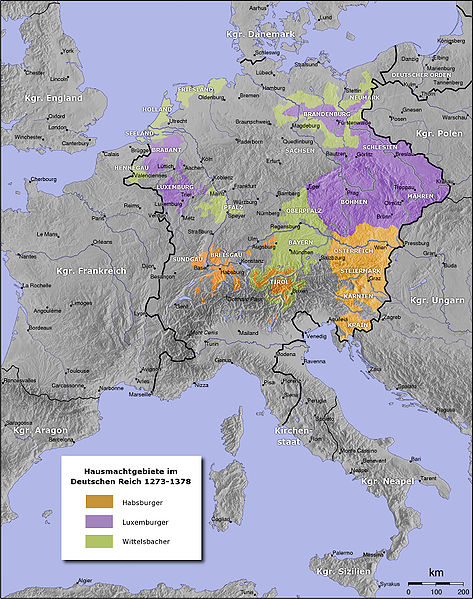
The three royal houses contending for the imperial crown of the Holy Roman
Empire at the time of the rebellion in Nurnberg.
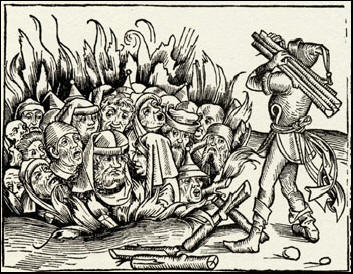
The knight Rindfleisch burns the Jews in Röttingen in 1298. (WeltChronik)