| Generations Back | Lineage | Number of Ancestors | Odds of Inheriting One or More Chromosomes | |
| 0 | Self | Kurt, Franz & Mark Langmann, b. 1954, 1958 & 1963 | -- | -- |
| 1 | Parent | Rudy Langmann, b. 1930 | 2 | 1.0000000, certain |
| 2 | Grandparent | Richard Robert Langmann, b. 1904 | 4 | 0.9999999, virtually certain |
| 3 | Great Grandparent | Harald Rudolf Langmann, b. 1881 | 8 | 0.9986621, almost certain |
| 4 | 2G Grandparent | Rudolf Wilhelm Georg Bernhard Langmann, b. 1840 | 16 | 0.9536355, about 21 out of 22 |
| 5 | 3G Grandparent | Johann Friedrich Christoph Langmann, b. 1802 | 32 | 0.7733585, about 3 out of 4 |
| 6 | 4G Grandparent | Karl Ludwig Caspar Langmann, b. 1767 | 64 | 0.5181970, about even |
| 7 | 5G Grandparent | Andreas Langmann, b. 1719 | 128 | 0.3038654, about 1 out of 3 |
| 8 | 6G Grandparent | Andreas Langmann, b. 1681 | 256 | 0.1650581, about 1 out of 6 |
| 9 | 7G Grandparent | Bartholomaus Langmann, b. 1648 | 512 | 0.0860868, about 1 out of 12 |
| 10 | 8G Grandparent | Bartholomaus Langmann, b. 1604 | 1024 | 0.0439698, about 1 out of 23 |
| 11 | 9G Grandparent | Joachim Langmann, b. 1560 | 2048 | 0.0222213, about 1 out of 45 |
| 12 | 10G Grandparent | Nicolaus Langmann, b.abt.1530 | 4096 | 0.0111117, about 1 out of 90 |
| 13 | 11G Grandparent | Heinrich Langmann, b.abt.1485 | 8192 | infinitesimal |
| 14 | 12G Grandparent | Joachim Langmann, b.abt. 1450 | 16384 | -- |
| 15 | 13G Grandparent | Nicolaus Langmann, b.abt. 1410 | 32768 | -- |
| 16 | 14G Grandparent | Peter Langmann, b.abt. 1360 | 65536 | -- |
| 17 | 15G Grandparent | Heinrich Nicolaus Langmann, b. 1323 | 131072 | -- |
| 18 | 16G Grandparent | Hans Langmann, b.abt. 1280 | 262144 | -- |
| 19 | 17G Grandparent | Conrad Langmann, b.abt. 1240 | 524288 | -- |
| 25-26 (?) | 23G Grandparent | Ioannes Langmann, b.abt. 980 | 33554432 | -- |
How y-DNA is passed from generation to generation: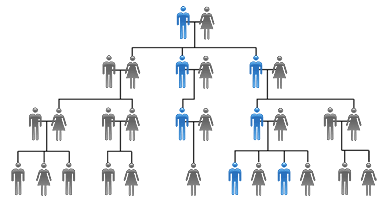
The table above can easily be modified by substituting another known all-male lineage from 0 to X generations.