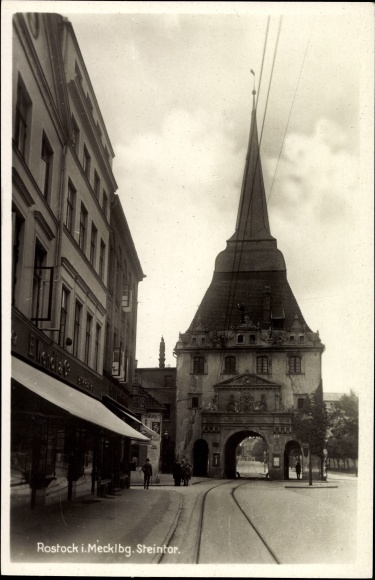
 | The warning sign on the stone portal in Rostock
Our ancestors had the agreeable custom of painting a clever motto such as a quotation or a Bible verse that they had adopted as a family motto on top of the doorways to their homes. Here, where they daily passed through on their way in and out, were the words to be clearly read as a constant reminder, something to think about and to keep in mind. After the same manner such quotations could be seen painted on public buildings such as churches, schools, city halls and portals, all places that saw heavy traffic, and very often further adorned with an important illustration that made the motto stand out even clearer and easier understandable.
That this custom also was used in Rostock can be seen by looking up at the Steinthor (Stone Portal) itself. This building shows on both sides the crests of the city and of the Land Mecklenburg, and further carry the wording: Sit intra te concordia et publica felicitas (Inside your wall harmony and public well-being thrives). Over this inscription is a half-length portrait of a man who holds a round shield in his left hand, and the date 1314.
Since the Steinthor only was erected in 1575 this earlier date has little to do with the building, but instead points to the end of a citizens revolt (known as the Domfehde) that saw the peace agreement with Henry the Lion, the duke of Mecklenburg, and the reinstalling of old law and order. Thanks to the treason of the royal Danish governor in Rostock, Hermann von Gloeden (or Kloedt), it became possible for the duke in January of 1314 to take the city by a surprise attack centered at the Steinthor--which had been left unlocked.
The legendary source of the event can be read above the picture:
Towards the beginning of the year 1314 the old free and independent Hansestadt was involved, as was by no means unusual, in war. Henry's army had for a long time laid siege, but could not take the city, and even an attempt at starving out the citizens did not succeed. Then treason was resorted to. It was a burgomaster who, blinded by the gold of the enemy, delivered the city into his hands.
The arrangement was well planned, even happened during daylight hours. And with the city burghers now enjoying peace (but no longer independence), the traitor was grabbed and thrown into prison. At the time misdemeanors were often severely punished, and obviously the culprit in this case was treated not just harshly but indeed horribly. The vanquished citizens dragged the unfortunate man through the portal, to a place behind the houses on the new street alongside the wall where he was placed in a pillory held by neck, arm, chest and leg irons that only allowed him to move his hands to the mouth. In this way he was slowly being killed, since for food he was only being given a daily ration of a small round piece of bread and a few drops of water.
The picture was placed on the portal as a warning to other people, and the neck and arm irons can be clearly seen. The round shield symbolizes the round bread. <---The Steinthor as seen in 1932
|