The first European: Created from fragments of fossil, the face of our forebears35,000 years ago
By DAVID DERBYSHIRE
Timeline for the human race
Dressed in a suit, this person would not look out of place in a busy street ina modern city.
The clay sculpture, however, portrays the face of the earliest known modern European- a man or a woman who hunted deer and gathered fruit and herbs in ancient forestsmore than 35,000 years ago.
It was created by Richard Neave, one of Britain's leading forensic scientists,using fossilised fragments of skull and jawbone found in a cave eight years ago.
The first modern European: Forensic artist Richard Neave reconstructed the facebased on skull fragments from 35,000 years ago
His recreation offers a tantalising glimpse into life before the dawn of civilisation.It also shows the close links between the first European settlers and their immediateAfrican ancestors.
To sculpt the head, Neave called on his years of experience recreating the appearanceof murder victims as well as using careful measurements of bone.
It was made for the BBC2 series The Incredible Human Journey. This program followsthe evolution of humans from the cradle of Africa to the waves of migrationsthat saw Homo sapiens colonise the globe. | | 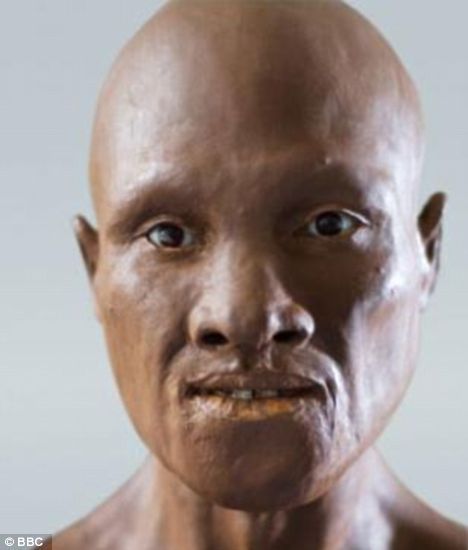 |
Meet the ancestors: DNA study pinpoints Namibia as home to the world'smost ancient race
The head has taken pride of place on the desk of Alice Roberts, an anthropologistat Bristol University, who presents the program.
'It's really quite bizarre,' she told Radio Times. 'I'm a scientist and objectivebut I look at that face and think "Gosh, I'm looking at the face of somebodyfrom 40,000 years ago" and there's something weirdly moving about that.
'Richard creates skulls of much more recent humans and he's used to looking atdifferences between populations.
'He said the skull doesn't look European or Asian or African. It looks like amixture of all of them. 'That's probably what you'd expect of someone among the earliest populationsto come to Europe.'
'I look at thatface and think "I'm actually looking at the face of somebody from 40,000years ago"', Roberts says.
The head is based on remains of one of the earliest known anatomically modernEuropeans.
The lower jawbone was discovered by potholers in the Carpathian mountains inRomania in 2002. The rest of the fragments were found the following year.
The bones were carbon-dated to between 34,000 and 36,000 years ago when Europewas occupied by two species of humans. They were the Neanderthals, who had arrived from Africa tens of thousands ofyears earlier, and the more recent modern humans, also known as Cro-Magnons.
Although the skull is similar to a modern human head, it has a larger cranium,is more robust and has larger molars. Although it is impossible to work out theskin colour of the prehistoric hunter, it is likely to have been darker thanmodern white Europeans.
Fossil experts are also unsure if the skull was male or female.
Many scientists believe that modern humans evolved in Africa 200,000 to 100,000years ago. Our ancestors left Africa around 60,000 years ago and migrated aroundthe world, replacing other branches of the family tree which had left the continentearlier.
The earliest modern Europeans were far from primitive. Living in huts and caves,they used stone tools and spears made from antlers, painted on the walls of theircaves and made jewellery from shells.
Timeline for the human race