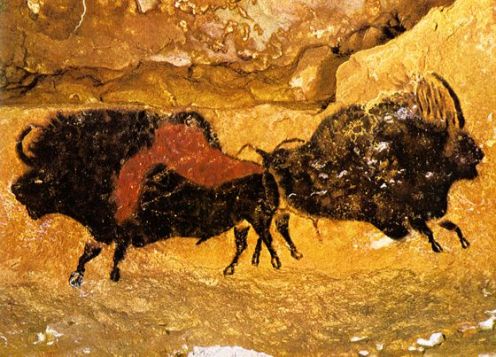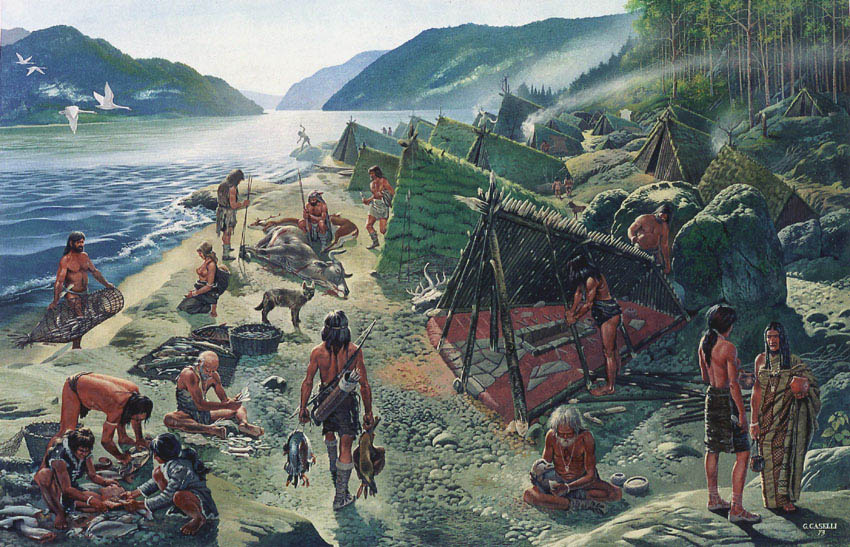
Life in a Stoneage (Upper Paleolithic) European village, 40,000 years ago
The Origins of Mankind
Life in a Stoneage (Upper Paleolithic) European village, 40,000 years ago
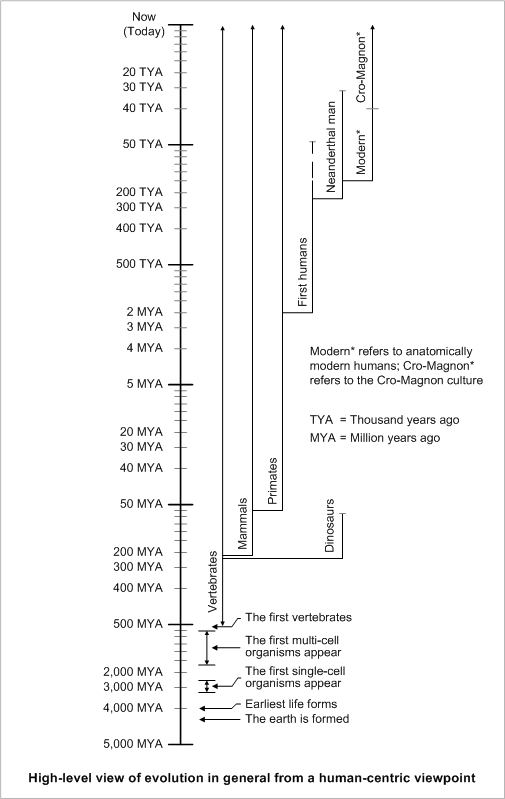
This page lists events in the early prehistory of the universe and the Earth, up to approximately 10,000 BC. Note that many of these dates are speculative or very rough estimates. For events from 10,000 BC onwards, see 10th millennium BC. For greater detail see the articles on the various geological periods.
And God created the Heaven and the Earth...
• 13.7 ± 0.2 billion years ago: Beginning of the Universe (the Big Bang).
• 13.2 billion years ago: Existence of the first known star-forming galaxies.
• 4.6 billion years ago: The solar system begins to form.
• 4.5 billion years ago: Formation of the Earth (see Age of the Earth).
The beginning of life
• 3.9 to 4.1 billion years ago: Origin of life (cyanobacteria).
• 2.3 billion years ago: First known Snowball Earth ice age (the entire Earth covered with ice; thus the name).
• 1.8 to 2.1 billion years ago: Appearance of the earliest Eukaryotes (type of cells making up plants and one-celled organisms, but not animals).
• 750 million years ago: Beginning of a possible Snowball Earth ice age.
• 600 million years ago: First complex multicelled lifeforms (Prokaryotes).
• 580 million years ago: End of possible Snowball Earth ice age.
• 575 million years ago: Origin of the oldest animal fossils.
• 540 million years ago: End of the Precambrian period and beginning of the Cambrian. Time of the Cambrian explosion and appearance of the first Vertebrates.
• 500 million years ago: Ordovician period begins.
• 435 million years ago: Silurian period begins.
• 420 million years ago: First creatures with lungs.
• 400 million years ago: Devonian period begins.
• 340 million years ago: Carboniferous period begins.
• 280 million years ago: Permian period begins.
• 251.4 million years ago: the Permian mass extinction. Palaeozoic era ends. Beginning of the Triassic period, the Mesozoic era and of the emergence of the dinosaurs.
• 195 million years ago: Jurassic period begins; appearance of the earliest mammals.
• 135 million years ago: Cretaceous period begins.
• 65 million years ago: Cretaceous-Tertiary extinction event at the end of the Cretaceous period (end of the Mesozoic era); start of the Tertiary period (Cenozoic era). End of the age of the dinosaurs. Scientists theorize that the K-T extinctions were caused by one or more catastrophic events, such as massive asteroid impacts or volcanic activity.
• 60 million years ago: First primates begin to evolve.
• 49 million years ago: Whales (up until then, land animals) return to the water.
• 40 million years ago: Age of the Catarrhini parvorder; first canines evolve. Man's best friend here long before Man.
• 36 million years ago: End of Eocene, start of Oligocene epoch.
• 34 million years ago:Cats begin to evolve.
• 26 million years ago: Emergence of the first true elephants.
• 24 million years ago: Miocene epoch begins.
• 20 million years ago: First forms of grass appear.
• 18-12 million years ago: Emergence of the Hominidae family. (Apes and ancestors of Man).
• 5-7 million years ago: Pan/Homo split. Closely related, Man and Chimpanzee part ways.
• 5.5 million years ago: Appearance of the genus Ardipithecus.
• 5 million years ago: Pliocene epoch begins.
• 4.5 million years ago: Appearance of the genus Australopithecus, maybe ancestor to the genus Homo.
• 4 million years ago: Start of last ice age.
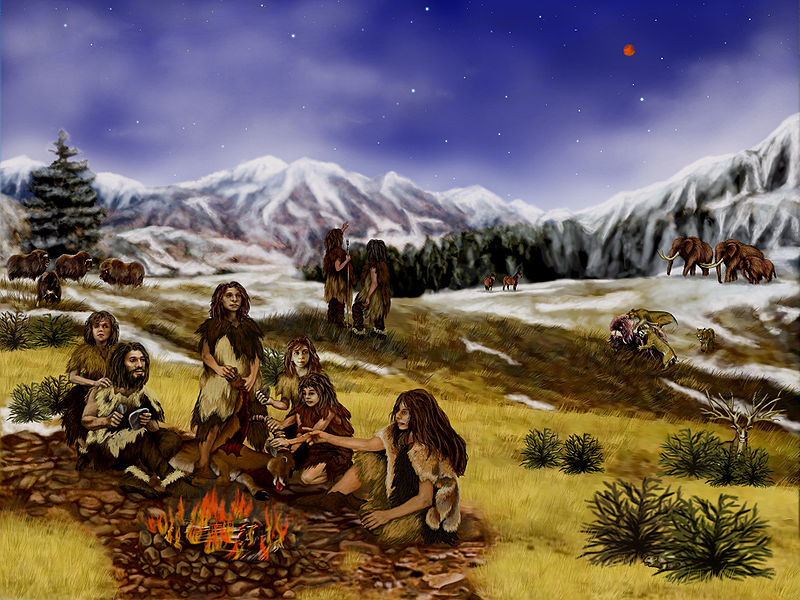
Neanderthals, our earliest cousins, roamed the Earth 30,000 to 250,000 years ago
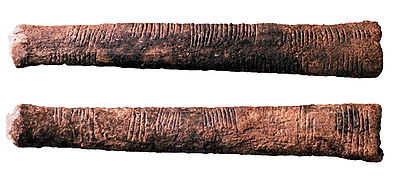
| • 2.5 million years ago: Emergence of the genus Homo. • 1.5 million years ago: Pleistocene epoch (Quaternary period) begins;earliest possible evidence of the controlled use of fire by Homo erectus. • 790,000 years ago: Earliest demonstrable evidence of the controlled useof fire by Homo erectus. • 700,000 years ago: Last reversal of the earth's magnetic field. • 500,000 years ago: Colonisation of Eurasia by Homo erectus. • 300,000 years ago: Homo sapiens separated from Homo erectus (MiddlePaleolithic). • 250,000 years ago: Appearance of Homo neanderthalensis. • 200,000 years ago: Appearance of Homo sapiens. • 160,000 years ago: Split between Homo sapiens idaltu and Homosapiens sapiens. • 150,000 years ago: time of mitochondrial Eve • 125,000 years ago: Peak of the Eemian Stageinterglacial. • 100,000 years ago: Earliest estimate for the domestication of dogs. • 90,000 years ago: time of Y-chromosomal Adam • 75,000 years ago: Ancestors of the Indigenous Australians reached Australia. • 70,000 years ago: Possible Toba catastrophic event. • 60,000 years ago: Out of Africa migration. • 40,000 years ago: Cro-Magnon colonisation of Europe (Upper Paleolithic) • 29,000 years ago (27,000 BC): Extinction of Homo neanderthalensis. • 23,000 BC: First colonisation of North America. • 19,000 BC: Last Glacial Maximum. • 18,000 BC: The oldest known mathematical tool (the Ishango Bone) • 10,000 BC: Land ice leaves Denmark and southern Sweden; start of theHolocene epoch and Neolithic Age and end of the last Ice Age. Categories: Prehistory | Ancient timelines |
|
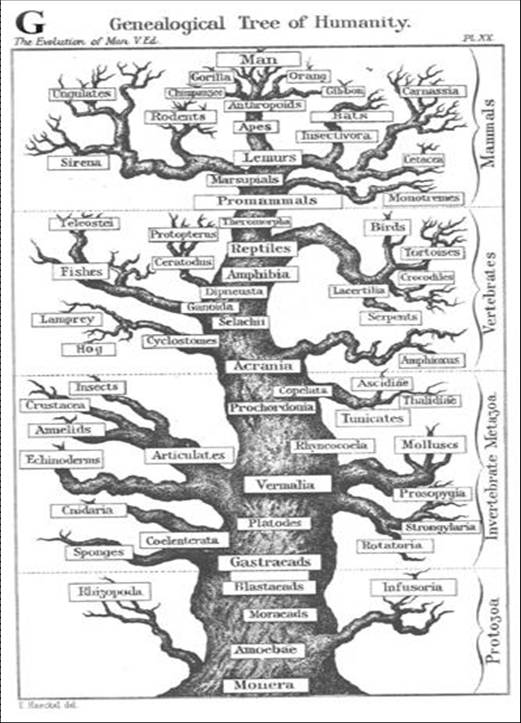
Meet the Ancestors
Writers have been around for 30,000 years
  |
Volcanic explosion 71,000 years ago reduced the world human population to a possible 2,000 souls
According to the Toba catastrophe theory, the consequences of a massive volcanic eruption drove the world's human population to the brink of extinction between 70,000–75,000 years ago when the Toba caldera in Indonesia underwent an eruption of category 8 (or "mega-colossal") on the Volcanic Explosivity Index, releasing between 2500 and 3000 km3 of dense rock equivalent.
Genetic evidence suggests that all humans alive today, despite apparent variety, are descended from a very small population, perhaps between 1,000 to 10,000 breeding pairs about 70,000 years ago.